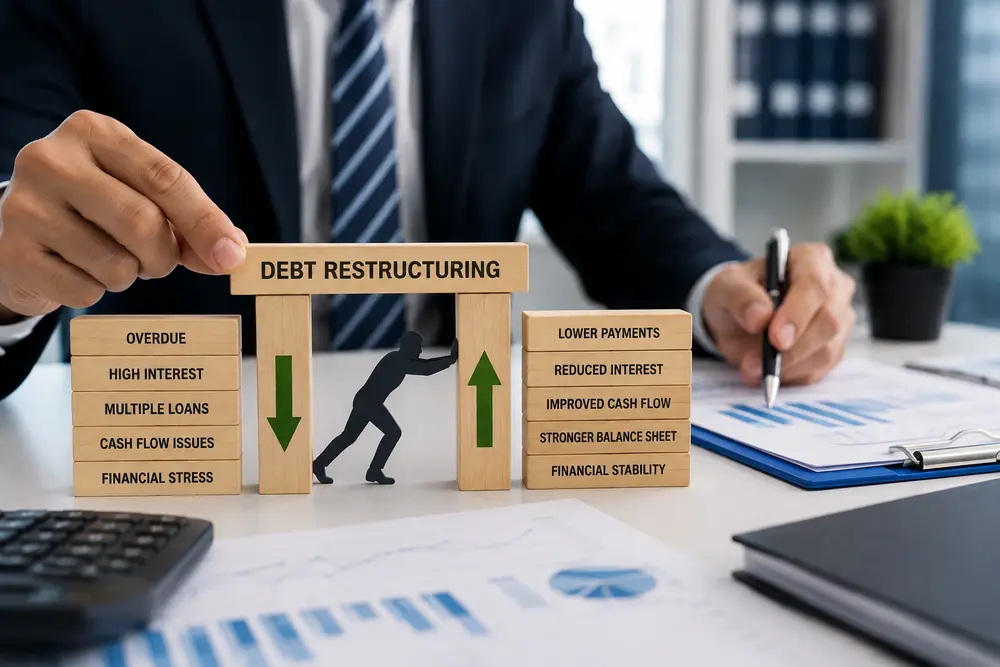
The debt management process may be daunting, and debtors may overwhelm individuals and businesses, particularly when the debts increase at a higher rate than the income. Debt restructuring can be used in this case to offer a workable solution. Debt restructuring in UAE is a financial methodology that assists borrowers in restructuring their current debts in order to ease repayment and make it manageable. Debt restructuring enables borrowers to enter into new agreements with creditors and resume normalcy instead of defaulting on them or being sued.
This paper provides the definition of debt restructuring, the procedure, and why it may be a good solution for people and businesses that cannot fulfill their financial obligations.

Understanding Debt Restructuring
Debt restructuring can be defined as a process of renegotiating the conditions under which the current loans or financial obligations are provided in order to ease repayment of the said loans by the borrower.
The central objective of the debt restructuring is to enable the borrowers to better handle their debt and prevent default or bankruptcy. In case a borrower is in difficulties, creditors can negotiate to change the initial terms due to the fact that partial or late payment is usually more preferable to no payment at all.
The restructuring of debts may be implemented on personal loans, credit cards, business loans, or even big company and government debts. It is a financial recovery measure that is popularly applied when borrowers are unable to fulfill their current repayment commitments.
Why Debt Restructuring Is Needed
Many factors might lead an individual or business to consider restructuring the debts. Unexpected situations like loss of a job, economic recessions, an increase in interest rates, or a decrease in business revenue may be a source of financial difficulties.
Some of the typical circumstances that cause debt restructuring include:
- Large monthly loan payments that are hard to afford.
- Several debts are at high interest rates.
- The liquidity issues of a company.
- Existence of credit risk or lawsuits by creditors.
- Notable alterations in the financial situation.
Restructuring in such situations offers a window through which a more realistic repayment plan can be developed and finances recovered.
How Debt Restructuring Works
The restructuring of debts is a form of negotiation between the lender and borrowers to change the terms of the loan. The procedure is not always the same based on the monetary state of affairs, yet it usually involves a series of processes.
1. Financial Assessment
The initial one is the examination of the financial case of the borrower. This will involve checking income, expenses, assets, liabilities, and the amount of debt itself. This gives a clear picture of the financial situation, and therefore, the restructuring is the best option.
2. Negotiation with Creditors
After financial analysis, the borrower or a financial advisor is now left to negotiate with creditors. The objective is to mutually agree on new conditions under which the repayment will be affordable, but would at the same time safeguard the interests of the creditor.
3. Modification of Loan Terms
Alteration of the current loan agreement can be done after negotiations. This may involve lowering the interest rates, prolonging the repayment period, or establishing a new repayment period.
4. Implementation of the New Plan
When the new conditions are arrived at, the borrower will start making payments under the new structure. This will ease the financial burden, and creditors will be able to pay the lender at a slow pace.
Restructuring of debt heavily depends on the communication and collaboration between lenders and borrowers in order to arrive at a common ground.
Common Types of Debt Restructuring
Restructuring of debt may be in various forms, as per the financial scenario and the negotiations between the creditors and the borrowers.
-
Interest Rate Reduction
Creditors can agree to reduce the interest rate charged on a loan to make the total cost of borrowing cheaper and easier to make monthly payments.
-
Extended Repayment Period
There are instances where the loan tenure can be increased, and the borrowers can pay over a longer time, resulting in a lower amount of the monthly installment.
-
Debt Settlement
One creditor can choose to accept a lump-sum payment that is less than the amount owed in the first place.
-
Debt Consolidation
Several debts can be grouped into one credit with improved conditions, and repayment would be easier.
-
Debt-to-Equity Conversion
Part of the debt in business restructuring can be converted into company shares, which will enable the creditors to own part of the company, but in exchange, the businessman can reduce the debt he owes.
Benefits of Debt Restructuring
The benefits of debt restructuring to both the borrowers and creditors are numerous.
1. Improved Cash Flow
Reduced payments each month make it easy to control finances and be financially stable.
2. Avoiding Bankruptcy
Restructuring gives an option to bankruptcy, whereby borrowers are given a chance to pay debts under new conditions.
3. Reduced Financial Stress
A repayment schedule that is manageable would decrease the stress that comes with a huge debt.
4. Maintaining Creditor Relationships
The new terms are also negotiated to maintain good terms with lending bodies and financial institutions.
5. Long-Term Financial Recovery
Restructuring would provide the borrowers with a chance to regain financial stability and enhance creditworthiness in the long run.
Also Read – Debt Restructuring in UAE: Options to Regain Financial Control
When Should You Consider Debt Restructuring?
Debt restructuring is to be taken into consideration in case debt repayments become hard, yet there is still a possibility of repaying the obligations at the new terms, which are assumed to be realistic. It is necessary to take early action since taking it too late can result in penalties, legal action, or credit history damage.
The situation can be analyzed with the help of professional financial advisors who will be able to negotiate with creditors and design a determined repayment plan that meets the financial ability of the borrower.
Conclusion
Restructuring of debts is an effective financial tool for people and companies that find it hard to settle their debts. Borrowers will be able to control their finances once again by renegotiating the terms of their loans (including interest rates, repayment timelines, or loan balances) and preventing worse outcomes, such as bankruptcy.
To the financially strained individuals, it would be much easier and more efficient to consult the experts. Debt restructuring in the UAE is now a necessary financial fix for several individuals and companies that seek to stabilize their finances. Through the appropriate professional services, such as Global Debt Advisory, companies assist their clients to assess their financial position, bargain with their creditors, and use organized strategies that result in financial restoration in the long run.